A healthy refrigerator cycles: the compressor runs, the temperature drops, the compressor rests. If yours runs constantly — humming away hour after hour without pause — something is forcing it to work overtime. That means higher energy bills, accelerated wear on the compressor (the most expensive part), and often, food that is not as cold as it should be.
This guide walks through the checks in order of likelihood: door gaskets, condenser coils, temperature settings, ventilation, and frost buildup — all safe for a homeowner, no sealed-system work involved.
Safety first
Refrigerators are safe to work around with basic precautions: unplug the unit before cleaning coils or accessing the back panel (the compressor area has a capacitor that can hold a charge — do not poke around in the electrical box). Do not attempt anything involving refrigerant lines — sealed system work requires EPA certification and specialized equipment. If you see oily residue on refrigerant lines (a sign of a leak), stop and call a technician. Everything in this guide stays on the safe side of that line.
Check 1: Door gaskets (the usual suspect)
The rubber gaskets around the doors seal cold air in. When they fail, warm air leaks in continuously and the compressor never catches up. Test them:
- The dollar-bill test: close the door on a dollar bill at several points around the seal. You should feel resistance pulling it out everywhere. Spots with no resistance are leaking.
- Visual inspection: look for cracks, tears, warping, or sections pulling away from the door. Check the folds for mold and food debris — grime prevents sealing.
- Clean first: wash gaskets with warm soapy water, dry thoroughly, and apply a thin coat of petroleum jelly to keep the rubber supple. Retest — cleaning alone often restores the seal.
If gaskets are torn or permanently deformed, replacement is a moderate DIY job (new gaskets press or screw into a channel — soak them in warm water first to make them pliable) or a standard service visit. As an illustrative example, replacement gaskets typically cost in the tens of dollars — prices vary by model.
Check 2: Condenser coils
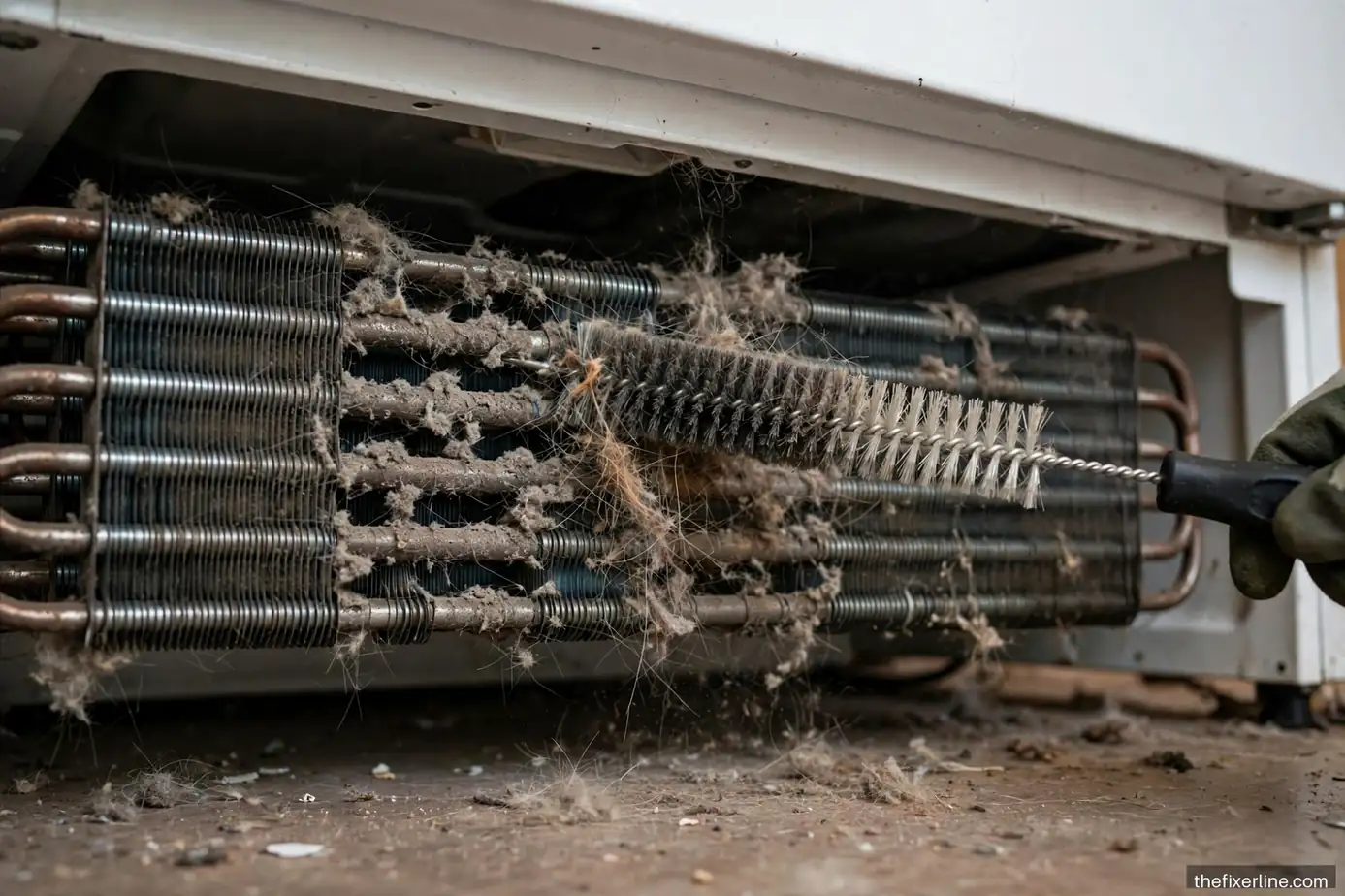
The condenser coils release the heat the fridge pulls from inside. When they are caked with dust and pet hair, heat cannot escape efficiently and the compressor runs longer to achieve the same cooling. On most models the coils are underneath (behind a front grille) or on the back:
- Unplug the refrigerator.
- Remove the front grille or pull the unit out to access the coils.
- Vacuum with a brush attachment, then use a coil brush (a long flexible brush made for this) to clean between the coils.
- Replace the grille, plug back in, and give it 24 hours to stabilize before judging.
Do this at least annually — every six months with pets. It is the single most neglected refrigerator maintenance task, and dirty coils are behind a remarkable share of “my fridge is dying” service calls that turn out to be a cleaning issue. Add it to your seasonal schedule — our 2026 home maintenance calendar includes it.

Check 3: Temperature settings
Verify the actual settings before assuming a mechanical problem. Ideal: refrigerator compartment 37–40°F (3–4°C), freezer at 0°F (-18°C). Common issues:
- Set too cold: if someone cranked the fridge to its coldest setting, the compressor runs far longer than necessary. Return to the recommended range.
- “Max cool” or “super” mode left on: many models have a boost mode for after grocery shopping — it runs the compressor continuously and is meant to be temporary. Check that it is off.
- Verify with a thermometer: built-in displays can be wrong. A $5 appliance thermometer left in the compartment for a few hours tells you the truth. If the actual temperature is fine but the compressor never rests, the thermostat or control board may be faulty — technician territory.
Check 4: Ventilation and location
Refrigerators need airflow around them to shed heat. Check:
- Clearance: most manufacturers specify a few inches of space on the sides, top, and especially behind. A fridge crammed tight into a cabinet alcove with no rear clearance overheats and runs constantly.
- Ambient temperature: a fridge in a hot garage in summer works far harder than one in a climate-controlled kitchen. Garage refrigerators in hot climates are chronic constant-runners — consider whether the location is the problem.
- Heat sources: direct sun through a window, proximity to the oven or dishwasher, or a heating vent blowing on the unit all add load.
- Level: a tilted fridge may not seal properly at the doors. Level it with the adjustable feet — doors should close on their own from a slightly open position when level is correct.
Check 5: Frost and ice buildup
In the freezer, heavy frost buildup insulates the cooling coils and blocks airflow — the system runs longer to compensate. If you see thick frost (more than a quarter inch):
- Check that the freezer door seals (same dollar-bill test) — chronic frost usually means a door sealing or defrost-system issue, not a one-time event.
- Manually defrost: unplug, remove food to coolers, leave doors open with towels to catch meltwater. Do not chip at ice with sharp tools — puncturing a refrigerant line turns a maintenance task into a major repair.
- If frost returns quickly after defrosting, the automatic defrost system (heater, thermostat, or timer) has likely failed — a standard technician repair.
Check 6: Usage patterns
Sometimes the “problem” is usage, not malfunction. A fridge packed so full that air cannot circulate cools unevenly and runs longer — leave space between items for airflow, especially around vents inside the compartment. Frequent long door openings (teenagers, entertaining) spike the load temporarily. And a fridge that was just loaded with a week’s warm groceries legitimately needs hours of continuous running to pull everything down to temperature — give it 24 hours after a big restock before diagnosing a problem.
When to call a technician
Call for service if: coils are clean, gaskets seal, settings are correct, and it still runs constantly (possible refrigerant issue, failing compressor, or bad thermostat — all sealed-system or electrical work); you find oily residue on refrigerant lines (leak — do not attempt repair); the compressor is extremely hot, making unusual noises (clicking, buzzing loudly), or cycling on and off rapidly (short-cycling suggests an electrical or compressor problem); or frost returns immediately after a full manual defrost (defrost system failure). Also call if the unit is under warranty — sealed-system and compressor work is often covered, and DIY attempts can void it.
Repair vs. replace
Consider replacement when: the fridge is 12–15+ years old and needs a compressor or sealed-system repair (the repair cost approaches the value of the unit, and efficiency gains from a new model are significant); multiple major components are failing; or energy bills suggest it has become an energy hog (older fridges use far more electricity than modern ones — a plug-in energy monitor can quantify this). A simple gasket or thermostat repair on a mid-life fridge is almost always worth doing; a compressor replacement on a 14-year-old fridge rarely is.
Reading compressor sounds
Your ears are a legitimate diagnostic tool. A healthy compressor hums steadily and quietly. Learn the abnormal sounds: loud buzzing or rattling that was not there before often means the compressor is straining (dirty coils are the first suspect) or a mounting spring has broken; repeated clicking every few minutes is the classic sound of a failing start relay — the compressor tries to start, the relay drops out, it tries again — and a start relay is one of the cheaper professional repairs, so do not ignore this sound; hissing (distinct from normal refrigerant flow sounds) can indicate a refrigerant leak, especially combined with warming temperatures — stop and call a technician. Normal sounds that worry new owners unnecessarily: gurgling and popping (refrigerant flowing and thermal expansion — normal), and the occasional loud crack from the freezer (ice and plastic expanding — normal). Knowing which sounds matter saves both panic and complacency.
Quantifying the problem with an energy monitor
If you want data rather than impressions, a plug-in energy monitor (illustratively in the tens of dollars) tells you exactly what the fridge consumes. A healthy modern refrigerator typically draws in the low hundreds of kilowatt-hours per year — check your model’s energy guide label for its rated consumption and compare. A unit drawing double its rated consumption with the checks in this guide already done has an underlying problem worth a service call; a unit drawing near its rating but running often may simply be in a hot location or heavily used. The monitor also settles the repair-vs-replace question with numbers: multiply the excess consumption by your electricity rate and the years of remaining life, and you have the true cost of keeping an inefficient unit running. Data beats guessing on decisions this size.
Frequently asked questions
How much running is normal?
A healthy fridge runs roughly 40–80% of the time depending on conditions — more in summer, after restocking, or in a warm kitchen. “Constantly” in this guide means effectively 100%: you never catch it at rest over a full day of observation. Some cycling is normal and healthy.
My fridge is louder than it used to be. Related?
Possibly. Increased noise with constant running often points to the same causes (dirty coils making the compressor strain, or a failing condenser fan). But new rattling or buzzing can also be something simple — the unit vibrating against a wall or a loose drain pan underneath. Check the simple causes first.
Can I keep a refrigerator in the garage?
It depends on your climate and the model. Most standard fridges are designed for indoor temperature ranges; in very hot garages they run constantly and in freezing garages the freezer may not stay frozen (the thermostat gets confused). Some manufacturers make garage-ready models rated for wider temperature ranges. If yours runs constantly in the garage, the location — not the fridge — is likely the issue.
Do I really need a special coil brush?
A vacuum with a brush attachment handles the surface dust, but the coil brush (long, flexible, inexpensive) reaches between the coil fins where the insulating blanket of dust actually lives. For the ten minutes and few dollars it costs, it makes the cleaning genuinely effective rather than cosmetic. Your dryer’s lint system deserves the same annual attention, by the way.
What to read next
Keep every appliance efficient: dishwasher drainage checks and dryer vent cleaning.
Safety note: This article is general information, not professional contractor advice. Unplug before cleaning coils or accessing panels, never attempt sealed-system or refrigerant work yourself, and call a certified technician for compressor, refrigerant, or electrical faults.