You open the dishwasher to find standing water in the bottom and dishes that are not quite clean. Before you assume the pump has failed and call for service, work through the simple checks in this guide — a clogged filter, a kinked drain hose, or a blocked air gap account for the large majority of dishwasher drainage problems, and all are fixable without tools or with basic ones.
We will go in order from simplest to most involved, so stop as soon as the problem resolves. Each step takes only a few minutes.
Safety first
Dishwashers combine water and electricity, so respect both. Turn off the dishwasher’s breaker before reaching into standing water or disconnecting any hoses — water and live electrical components are a dangerous combination. Never bypass safety interlocks (like the door latch switch) to run the unit with the door open. If you encounter damaged wiring, scorch marks, or a breaker that trips repeatedly, stop and call a professional — those are electrical issues, not drainage issues.
Check 1: The filter (most common cause)
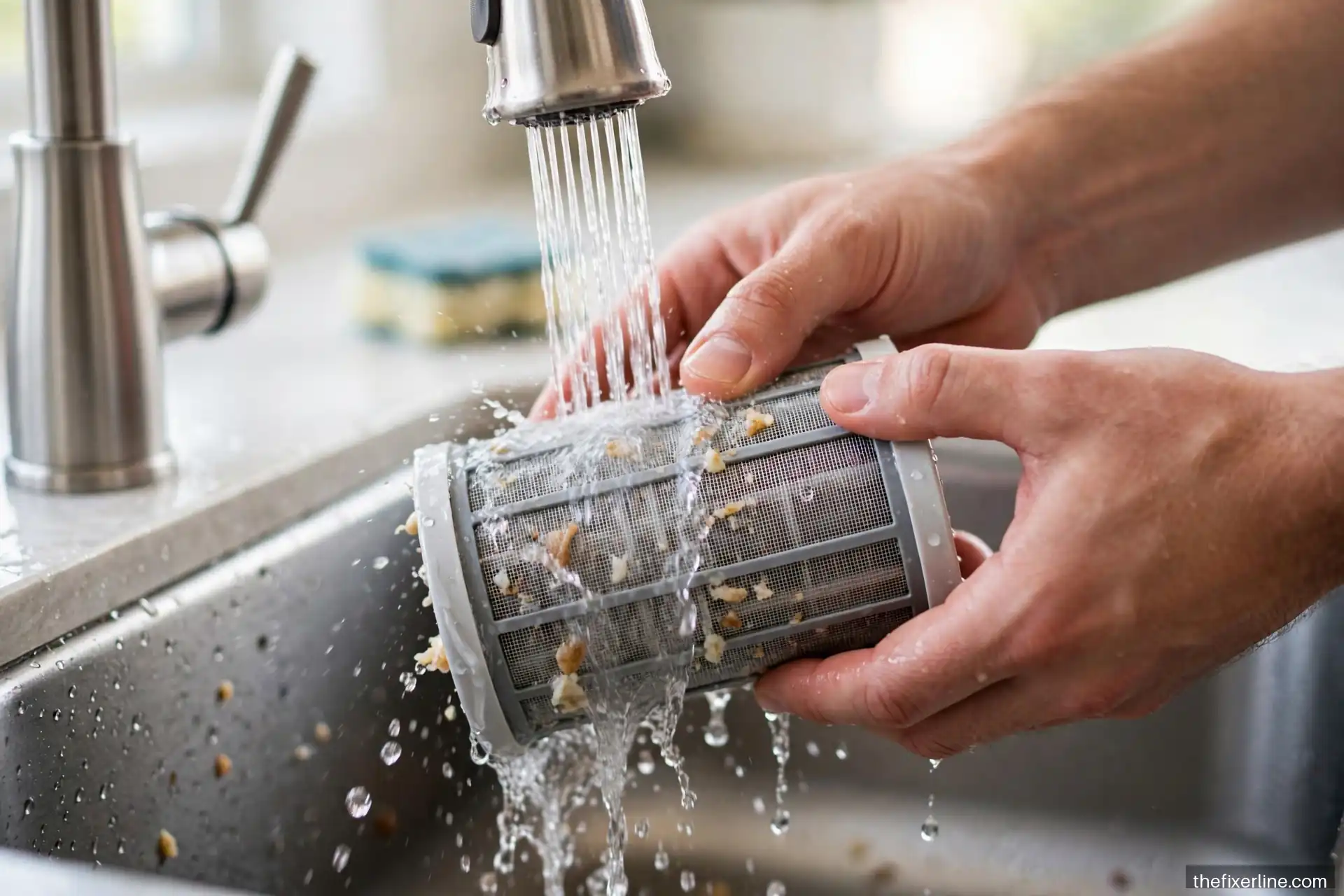
Modern dishwashers have a removable filter assembly at the bottom of the tub — a cylindrical or flat mesh filter that catches food particles. When it clogs, water cannot drain properly and cleaning performance collapses.
- Remove the bottom rack.
- Twist out the filter assembly (usually a quarter-turn counterclockwise — check your manual if it resists).
- Rinse it under hot water, scrubbing with a soft brush and dish soap. Remove trapped food, glass shards (carefully), and the slimy biofilm that accumulates.
- While it is out, wipe the sump area underneath with a cloth.
- Reinstall, run a short cycle, and check drainage.
Make filter cleaning a monthly habit — it takes two minutes and prevents most drainage and odor problems. If you have never cleaned yours, the improvement after the first cleaning is often dramatic.
Check 2: The garbage disposal connection
Most dishwashers drain through the garbage disposal. If the disposal is jammed, clogged, or was recently replaced, the dishwasher cannot drain:
- Run the disposal with water flowing for 30 seconds — a jammed disposal blocks the dishwasher’s drain path. See our disposal troubleshooting guide if it is jammed.
- New disposal installed? New disposals ship with a plastic knockout plug sealing the dishwasher inlet. If the installer forgot to knock it out, the dishwasher drain is completely blocked. With power off, disconnect the dishwasher hose from the disposal nipple and check — if the plug is still in place, knock it out with a screwdriver and hammer, retrieve the plastic piece, and reconnect.
Check 3: The air gap
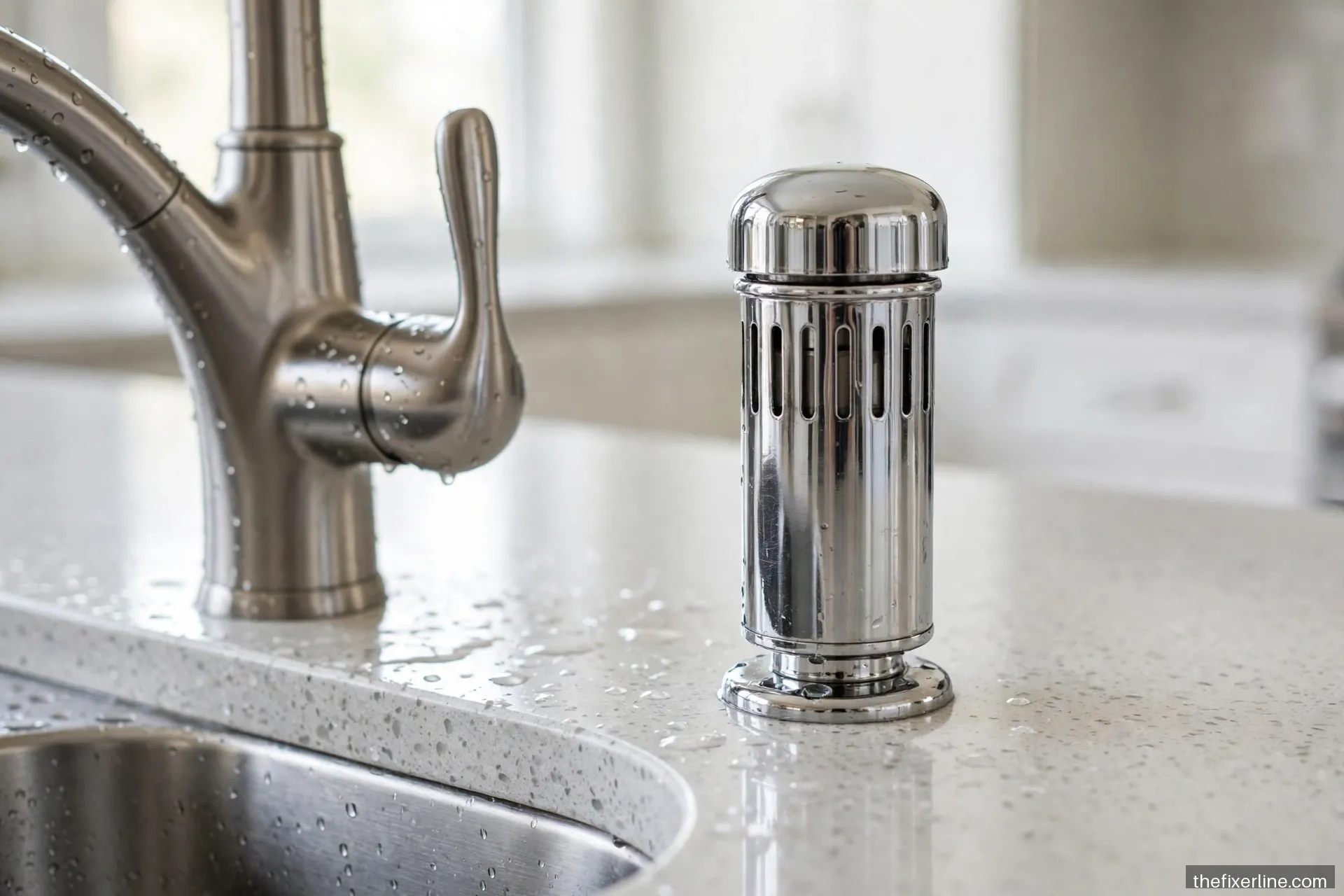
The air gap is the small chrome or stainless cylinder on the sink deck next to the faucet (not all installations have one — some areas allow a high-loop instead). It prevents dirty sink water from siphoning back into the dishwasher, and it clogs:
- Pull off the air gap cover.
- Remove any visible debris — food particles and mineral buildup collect here.
- Use a bottle brush or a straightened wire to clear the openings.
- Replace the cover and run the dishwasher.
If water spurts from the air gap during draining, that is the classic symptom of a downstream blockage — the water is backing up because it cannot get past an obstruction further along. Continue to the drain hose check.
Check 4: The drain hose
The drain hose runs from the dishwasher to the disposal or sink drain. With the breaker OFF:
- Pull the dishwasher forward slightly (or access from under the sink) to inspect the hose’s full length.
- Look for kinks, crushing (often from the dishwasher being pushed back too far), or sharp bends. Straighten any kinks — a kinked hose is a blocked hose.
- Check the high loop: the hose should rise up and be secured high under the countertop before descending to the drain connection. This loop prevents backflow. If it has fallen, re-secure it with a zip tie or bracket.
- Disconnect the hose at the disposal/sink end (bucket and towels ready) and check for clogs at the connection nipple — food and grease accumulate here. Clear with a brush or wire.
Check 5: The drain pump area
If the filter, disposal, air gap, and hose are all clear, the issue may be at the drain pump itself — often just debris (glass, pits, twist ties) lodged in the pump inlet:
- With power OFF at the breaker, bail out standing water with a cup and towels.
- Remove the filter assembly and the lower spray arm (usually lifts or unscrews off).
- Look into the sump for debris around the pump inlet. Remove anything you find with pliers or tongs — never fingers near pump impellers.
- Check that the check valve/flapper (a small rubber valve in the drain path on many models) moves freely and is not stuck shut with gunk.
Check 6: Run a cleaning cycle
Sometimes the drainage system is just gunked up with grease and detergent residue rather than blocked by a single obstruction. Run the empty dishwasher on its hottest cycle with a cup of white vinegar placed upright on the top rack (or a dishwasher cleaner per its directions). The hot water and acid dissolve the buildup coating the sump, pump, and hoses. Follow with a second empty hot cycle to rinse. This will not fix a mechanical blockage, but it restores marginal drainage and eliminates odors.
When to call for service
Call an appliance repair technician if: all the above checks pass and water still will not drain (likely a failed drain pump or a control issue); the dishwasher makes grinding or loud humming noises from the pump area; you find damaged wiring or the breaker trips; water leaks from underneath the unit (pump seal or hose failure — continued use risks floor damage); or the unit is under warranty (DIY disassembly may void it — check first). Also call if the dishwasher is very old and multiple components are failing — the service call that diagnoses a dead pump on a 12-year-old unit is often better spent toward replacement.
Preventing drainage problems
- Scrape, do not pre-rinse excessively: modern dishwashers and detergents are designed for dirty dishes — but scrape off large food chunks, bones, and labels that clog filters.
- Clean the filter monthly — the single highest-value habit.
- Run hot water at the sink before starting the dishwasher — the first fill is more effective hot, improving cleaning and reducing residue.
- Use the right detergent amount: too much creates excess suds and residue; too little cleans poorly. Follow the detergent’s guidance for your water hardness.
- Run it regularly: seals dry out and pumps seize in dishwashers that sit unused for months.
Hard water and detergent: the invisible drainage enemies
Two slow-acting culprits cause gradual drainage decline that owners mistake for mechanical failure. Hard water leaves mineral scale throughout the sump, pump, and hoses — narrowing passages over months until drainage suffers. If you have hard water (white scale on faucets is the tell), run a dishwasher cleaner or vinegar cycle monthly rather than occasionally, and consider whether your detergent is formulated for hard water. Detergent overdose is the other: excess detergent does not rinse clean, leaving a filmy residue that builds up in the same passages. More detergent is not more clean — it is more residue. Use the measured dose for your water hardness and load soil level, not a heaping scoop “to be sure.” Together, correct detergent dosing and regular descaling keep the drainage path clear indefinitely in most households.
When poor cleaning is not a drainage problem
It is worth distinguishing drainage failure from cleaning failure, since they overlap in symptoms but not in fixes. If dishes come out dirty but there is no standing water and the filter is clean, suspect: spray arms (remove and clear the jet holes with a toothpick — a single blocked jet leaves a dirty stripe on every load), water temperature (the dishwasher needs 120°F incoming water; run the hot tap before starting), or detergent issues. But if dirty dishes accompany standing water or a smelly sump, drainage is the root cause — dirty water is being left behind to redeposit on the dishes. Fix drainage first; cleaning performance usually recovers with it. Chasing cleaning settings while ignoring standing water is treating the symptom.
Frequently asked questions
Is a little standing water normal?
A small amount (less than an inch) in the sump area around the filter can be normal on some models — check your manual. Water covering the bottom of the tub or not draining between cycles is not normal and needs the checks above.
My dishwasher smells bad. Related to drainage?
Very often, yes — poor drainage leaves food-laden water sitting in the sump, which breeds odor. Clean the filter, run the vinegar cycle, and scrub the door gasket (another odor hideout). Persistent odor after drainage is fixed usually means the gasket or spray arms need attention.
We just got a new garbage disposal and now the dishwasher will not drain. Why?
The knockout plug — described in Check 2 above. It is the single most common cause of sudden dishwasher drainage failure after disposal replacement, and the fix takes five minutes once you know to look for it.
How long should a dishwasher last?
Typically 9–12 years with reasonable maintenance. If yours is past that and needs a pump replacement (one of the pricier repairs), compare the repair quote against replacement — putting significant money into a unit near end of life is rarely the best value. For broader appliance decision frameworks, our refrigerator guide covers similar repair-vs-replace thinking.
What to read next
Keep the kitchen flowing: garbage disposal troubleshooting and unclogging drains without chemicals.
Safety note: This article is general information, not professional contractor advice. Turn off the breaker before reaching into standing water or disconnecting hoses, and call a professional for electrical issues, pump replacement, or warranty-covered units.