A squeaky door hinge is one of those small household annoyances that somehow gets louder every single day — especially at night, when everyone else is asleep and you are trying to slip out of the bedroom without waking the house. The good news: in most cases you can silence it in under ten minutes, with a can of lubricant and no tools at all. Only a small minority of squeaks — bent pins, worn-out hinges, or a door that has dropped on its frame — need anything more involved, and even those are a thirty-minute job for a confident beginner. This guide walks through the quick fix first, then the proper fix, then what to do when the squeak keeps coming back.
Key Takeaways
- Most hinge squeaks are caused by dry metal rubbing on metal, and a proper lubricant fixes them in minutes.
- WD-40 is a cleaner and a short-term fix, not a long-lasting lubricant — white lithium grease or silicone spray lasts far longer.
- If the squeak returns within days, the hinge pin is probably dirty, bent, or worn, and needs cleaning or replacing.
- A door that squeaks AND sticks or sags has an alignment problem, not just a lubrication problem.
Why Door Hinges Squeak
A hinge is just two metal leaves joined by a pin, and every time the door moves, that pin turns inside the knuckles of the hinge. When the thin film of lubricant between the pin and the knuckle dries out, bare metal rubs on bare metal — and that friction is the creak you hear. Humidity speeds the process up: in damp rooms, bathrooms, and coastal homes, a fine layer of rust forms on the pin and makes the noise worse. Dust and grit work their way in too, acting like sandpaper inside the joint. And on heavy solid-core or exterior doors, the sheer weight of the door slowly wears the pin and the knuckle out of round, so the pin wobbles and groans with every swing. Knowing which of these is behind your squeak matters, because a dry hinge needs oil, a rusty hinge needs cleaning first, and a worn hinge needs a new pin.
What You’ll Need
You do not need a toolbox full of gear for this job. For the quick fix, one can of lubricant is enough. For the proper fix, add a hammer, a nail, and some steel wool.
Tools and materials:
| Item | What it is for | Cost (approx.) |
|---|---|---|
| A can of white lithium grease or silicone spray | Long-lasting lubrication inside the hinge knuckle | $5–$8 |
| WD-40 or similar penetrating oil | Cleaning rust and freeing a stuck pin | $4–$6 |
| Hammer and a large nail (or nail set) | Tapping the hinge pin up and out | Already at home |
| Fine steel wool or 220-grit sandpaper | Cleaning rust and grime off the pin | $3–$5 |
| Old rag and paper towels | Wiping drips and catching excess lubricant | Already at home |
| Replacement hinge pin | For a bent or worn pin (take the old one to the store to match it) | $2–$4 each |
| 3-inch wood screws | Replacing short hinge screws that have worked loose | $4–$6 a box |
Total outlay for a first-timer buying everything: roughly $10–$15, and the lubricant will last you years of squeaky hinges, sticky locks, and garage doors.
Which Lubricant Should You Use?
This is where most people go wrong, because the can most households already own — WD-40 — is the worst long-term choice for a hinge. WD-40 is a water displacer and a cleaner. It will silence a squeak beautifully for a week or two, and then it evaporates, leaving the hinge drier than before. Use it to clean a rusty pin, not to finish the job.
| Lubricant | Best for | How long it lasts | Watch out for |
|---|---|---|---|
| White lithium grease | Most interior and exterior hinges | 6–12 months | Thick and white; wipe drips or it shows on painted doors |
| Silicone spray | Bathroom, exterior, and humid-room hinges | 6–12 months | Can stain unfinished wood if it drips; wipe immediately |
| Petroleum jelly | A quick fix with what is in the bathroom cabinet | 2–4 months | Messy to apply and attracts dust over time |
| 3-in-1 oil or machine oil | A precise, drip-free application | 3–6 months | Thin, so it runs — use sparingly |
| WD-40 | Cleaning rust and freeing a stuck pin only | Days to a couple of weeks | Evaporates; never your final lubricant |
| Bar soap or candle wax | An emergency fix when nothing else is at hand | A few days | Crumbles and washes out fast |
If you are buying one product, buy white lithium grease in a spray can with a straw nozzle. It sticks to the pin, does not run, and survives humidity. Silicone spray is the better pick for bathroom doors and exterior doors, because it does not wash out and it will not go gummy in damp air.
How to Fix a Squeaky Door Hinge
Work through these steps in order. Most doors are fixed by Step 2, and almost all of the rest by Step 3.
Step 1: Find Which Hinge Is Squeaking
Open and close the door slowly while pressing your ear close to each hinge in turn — top, middle, and bottom. On a three-hinge door, the top hinge carries most of the weight and squeaks most often, but do not guess: a squeak travels, and lubricating the wrong hinge just wastes time. Once you have found the noisy one, put a folded towel or a piece of cardboard under the door to catch drips and stop the door from swinging while you work.
Step 2: The Two-Minute Fix (Without Removing Anything)
If you are in a hurry, you can often fix the squeak without taking the hinge apart. Hold the straw nozzle of your lubricant right at the top of the hinge knuckle — the small gap where the pin disappears into the hinge — and give it a short spray. Swing the door back and forth ten or twelve times to work the lubricant down inside. Spray again, swing again. If the squeak fades, you are done. This method works well on hinges that are simply dry, and it is the right first move on a door you cannot easily take apart. But if the hinge is rusty or full of grit, spraying over the top only papers over the problem, and the noise will be back within days.
Step 3: Remove the Pin and Lubricate It Properly
This is the fix that lasts, and it takes about ten minutes. Close the door so its weight rests on the hinges, and wedge a doorstop or a folded towel underneath to hold it steady. Tap the bottom of the hinge pin upward with a hammer and a large nail, working from underneath the hinge. Once the pin rises about half an inch, you can pull it out by hand — grip it with pliers if it is stubborn. Do one hinge at a time and never remove all the pins at once, or the door will fall.
Lay the pin on a rag. If it is dull grey with rust spots or black grime, rub it with fine steel wool until it shines, and wipe the inside of the hinge knuckles with a rag wrapped around a thin screwdriver. Then coat the pin with a thin, even layer of white lithium grease or petroleum jelly, slide it back into the hinge, and tap it gently home with the hammer. Swing the door a dozen times to spread the grease, and wipe away any excess that squeezes out. Repeat for any other hinge that squeaks. Nine times out of ten, this is the end of the story.
Step 4: Deal With Rust and Grime
If the pin comes out orange with rust, or the hinge knuckles are caked with grit, grease alone will not save it. Spray the pin and the inside of the knuckles with WD-40 and let it sit for five minutes, then scrub the pin with steel wool and work a rag through the knuckles. You will be surprised how much black grime comes out of a hinge that looked fine from the outside. Once everything is clean and dry, lubricate with lithium grease as in Step 3. A hinge that has been properly cleaned and greased should stay quiet for a year or more.
Step 5: Tighten the Screws and Check the Alignment
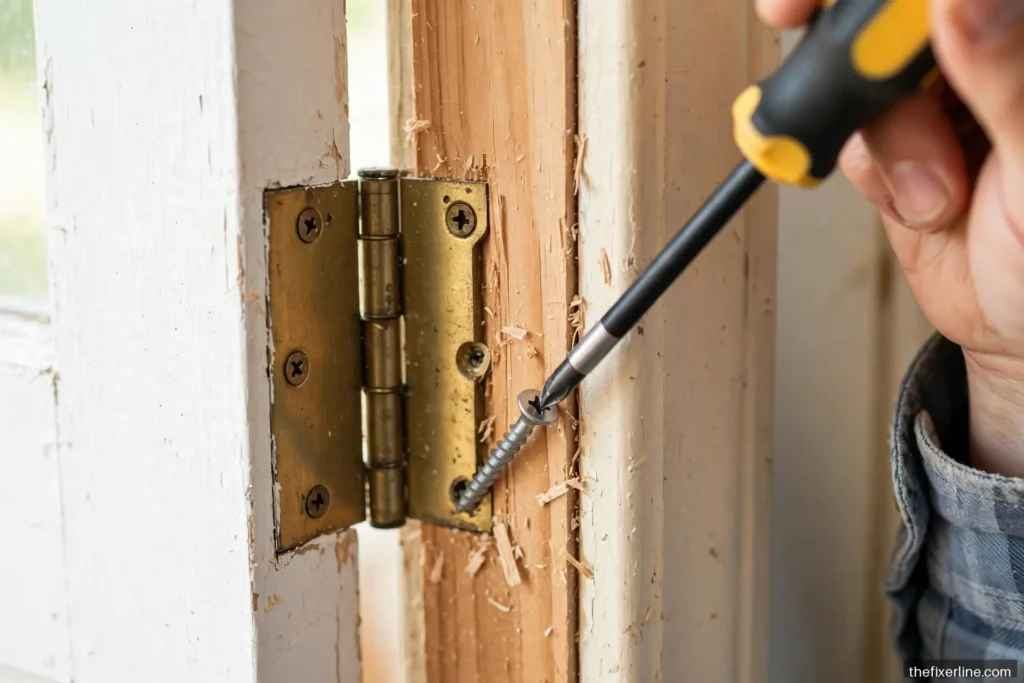
A hinge that has worked loose will squeak even when it is perfectly lubricated, because the hinge leaf shifts against the frame with every swing. Check each screw on the squeaking hinge and tighten any that turn freely. If a screw spins without gripping — the hole is stripped — pull it out, push two or three wooden toothpicks dipped in wood glue into the hole, snap them flush, and drive the screw back in once the glue is dry. Better still, replace one short screw per hinge leaf with a 3-inch wood screw that reaches the wall stud behind the frame; that single long screw often pulls a sagging door back into square and stops both the squeak and the sticking.
Step 6: Replace the Pin — or the Hinge
If a clean, greased pin still squeaks, look at the pin itself. Roll it on a flat table: if it wobbles, it is bent, and no amount of lubricant will fix it. Take it to a hardware store and match it — pins come in different diameters and lengths, and a pin that is too loose will rattle. If the hinge knuckles themselves are worn out of round, cracked, or the hinge leaves are bent, replace the whole hinge. Buy the same size (measure the leaf height and width), unscrew the old one leaf by leaf, and screw the new one into the same holes. A single standard interior hinge costs $3–$8, and swapping one takes fifteen minutes.
What If the Squeak Keeps Coming Back?
A squeak that returns within a week or two is telling you something. Here is how to read it. If it comes back after WD-40, you only ever applied a short-term product — clean the pin and finish with lithium grease. If it comes back after proper grease, the pin or knuckle is worn and needs replacing. If the door also sticks, rubs the frame, or will not latch, the door has dropped — tighten the top hinge screws and fit a 3-inch screw into the top hinge’s frame leaf, which pulls the door back up. And if every hinge in the house starts squeaking at once, check your humidity: a damp house corrodes pins faster, and a dehumidifier or better bathroom ventilation is the real fix, not more oil.
How Much Does It Cost to Fix a Squeaky Door Hinge?
Almost nothing, which is why this is one of the best-value DIY jobs in the house. Here is a realistic comparison, based on a single interior door with one squeaky hinge.
| Option | Cost | Time | Result |
|---|---|---|---|
| DIY with lubricant you already own | $0 | 2 minutes | Quiet for weeks to months |
| DIY with a new can of white lithium grease | $5–$8 | 10 minutes | Quiet for 6–12 months |
| DIY pin clean + grease + replacement pin | $10–$15 | 20–30 minutes | Quiet for years |
| DIY full hinge replacement | $15–$25 (hinge + screws) | 15–30 minutes | Like new |
| Hiring a handyman | $75–$150 (call-out fee) | 15 minutes of their time | Quiet, but a steep price for a ten-minute job |
Worked example: a house with five squeaky doors. One $7 can of white lithium grease, a $4 pack of replacement pins, and an hour of your time silences all five — about $11 total. A handyman would charge a minimum call-out of $75–$100 for the same visit, and would do exactly the same thing with the same can of grease. Save the professional for the doors that are sagging, binding, or have a damaged frame.
When to Call a Pro
Most squeaky hinges are a DIY job, but call a professional if the door frame itself is cracked, split, or pulling away from the wall; if the door has dropped so far that it will not close at all; if the hinges are on a heavy exterior or fire door and the screws will not hold even after the toothpick trick; or if you find signs of water damage or wood rot around the frame. Those are structural problems wearing a squeak as a disguise, and lubricant will not fix them. A carpenter can re-hang a door properly for $100–$200, which is far cheaper than letting a sagging door chew up its frame for another year.
Frequently Asked Questions
Why does my door hinge squeak only at night?
Temperature and humidity drop overnight, metal contracts slightly, and the house is quiet — so a squeak that was always there suddenly sounds twice as loud. A proper clean and grease fixes it regardless of the hour.
Can I use cooking oil on a squeaky hinge?
You can in an emergency, but you should not make a habit of it. Cooking oil goes rancid, turns sticky, and attracts dust, which makes the hinge worse within weeks. White lithium grease costs a few dollars and lasts a year.
Will WD-40 fix a squeaky door hinge?
Temporarily, yes — for a few days to a couple of weeks. WD-40 is a cleaner and water displacer, not a lasting lubricant. Use it to clean a rusty pin, then finish with white lithium grease or silicone spray.
How do I fix a squeaky hinge without removing the pin?
Spray lubricant with a straw nozzle into the top of the hinge knuckle, then swing the door back and forth a dozen times to work it inside. It works well on hinges that are just dry, but a rusty or gritty hinge needs the pin removed and cleaned.
Why does my door still squeak after oiling it?
Either the pin is dirty, bent, or worn out, or the hinge is loose on the frame. Remove the pin, clean it with steel wool, check that it rolls straight, tighten the screws, and if the squeak persists, replace the pin or the hinge.
Bottom Line
A squeaky door hinge is almost always a five-dollar, ten-minute job: find the noisy hinge, pull the pin, clean off the rust and grime, coat it with white lithium grease, and put it back. Skip WD-40 as your final lubricant, tighten any loose screws while you are there, and replace the pin if it is bent. The only time to call a professional is when the door is sagging, the frame is damaged, or the screws will not hold — everything else is a quiet evening’s work.